
India Post has released two commemorative stamps inspired by Axiom Mission 4, marking a symbolic milestone in India’s human spaceflight journey. The stamp honours astronaut Shubhanshu Shukla, the first Indian to stay aboard the International Space Station.
The stamps, along with souvenir sheets, were unveiled by Indian Space Research Organisation (ISRO) Chairman V. Narayanan in Bengaluru on Sunday. The release marked the International Day of Human Space Flight, highlighting India’s growing ambitions in crewed space missions. The collection features a mission patch designed by Manish Tripathi, founder of aantarDESI. Originally created as an emblem worn by Shukla during the mission, it has now been transformed into a national postal artefact through a collaboration initiated by ISRO and executed by India Post.
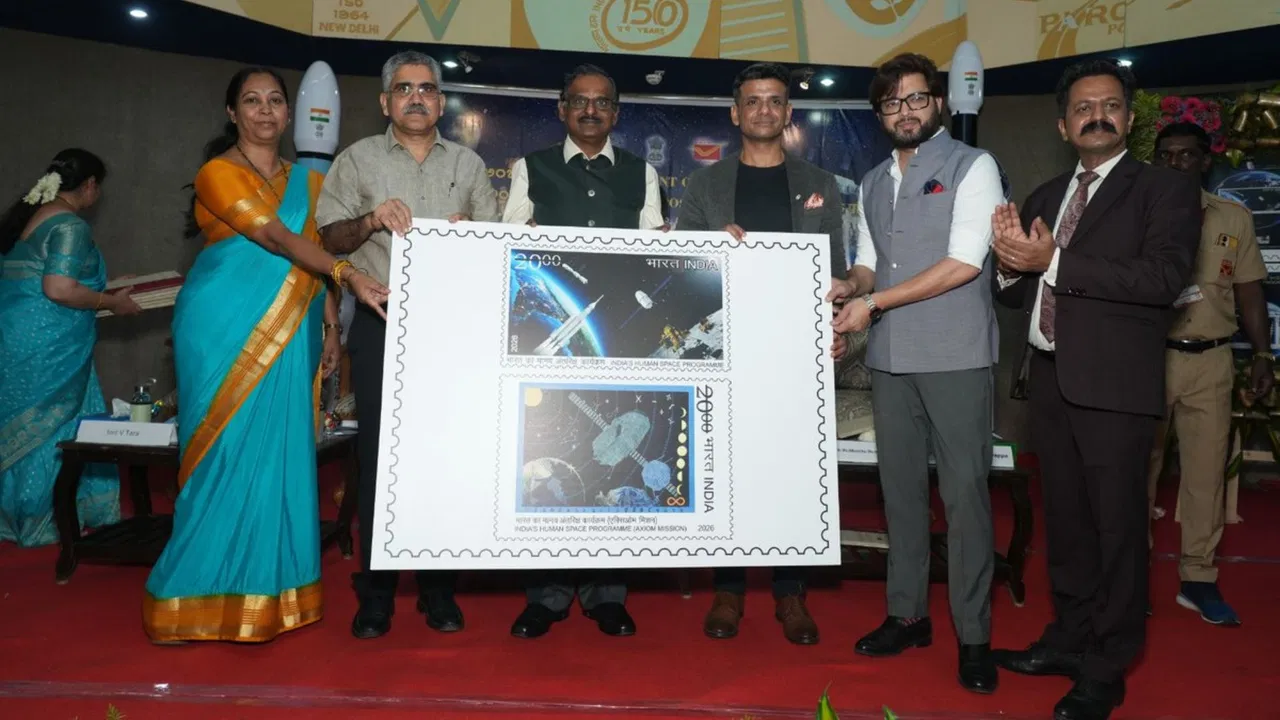
Tripathi said the recognition gives the design a lasting place in public memory. “To see a design that began as an emblem on an astronaut’s suit find a place in India’s postal history is incredibly humbling,” he told members of the press at the function. “A stamp is not just a medium of communication. It is a lasting record.”
He added that the idea of a stamp was part of the creative intent from the beginning. “My thought was that India is going to space, and this is like putting our mark there,” he said. “Now that it has become a postal stamp, it feels very special.” Shukla launched aboard Axiom Mission 4 on June 25, 2025.
The design process, according to Tripathi, took around four months. He said much of it was done using simple tools to preserve originality. “I didn’t use any fancy tools, just paper and hotel stationery,” he said. “I wanted the creative journey to remain original and not influenced by anything else.”
The patch brings together symbols representing India’s scientific heritage and space ambitions. It includes references to Aryabhata, the pi symbol, and Jantar Mantar. It also features Earth forming an astronaut’s face, the Gaganyaan capsule, and an infinity symbol representing continuity and learning.
Tripathi said the challenge was compressing India’s space story into a single visual identity. “The challenge was to capture India’s vast space legacy within a small format.”
He added that Shukla was closely involved in shaping the concept, which aimed to inspire younger generations to pursue space science and exploration. “He wanted to create something that inspires the coming generations,” Tripathi said.
The project also carried personal significance for the designer, who shares a hometown connection with Shukla. The journey concluded when Shukla presented him with the original patch that had flown to space.
“He also presented me with the space travel patch,” Tripathi said. “It felt like the journey had come full circle.”