MACAO (SAR): Nepal’s collectors won six medals, including a Gold, at the MACAO 2026 Specialized World Stamp Exhibition. The awards recognised years of original research into the country’s postal history, postal stationery and revenue stamps at the event in the Special Administrative Region (SAR) of China.
 Kicked off on June 26 at The Venetian Macao, the six-day event features around 1,500 competitive frames from more than 40 countries and regions. It is jointly organised by the Macao Post and Telecommunications Bureau and the Macau Philatelic Association under Fédération Internationale de Philatélie (FIP) patronage and the Federation of Inter-Asian Philately (FIAP) auspices.
Rishi Tulsyan led Nepal’s participation, with his exhibit “Postal Stationery of Nepal (1887–1950)” winning a Gold medal—the country’s top honour at the event. He also earned a Vermeil medal for “Nepal Revenues”, completing a notable double that underscores his status as Nepal’s most highly decorated philatelist. 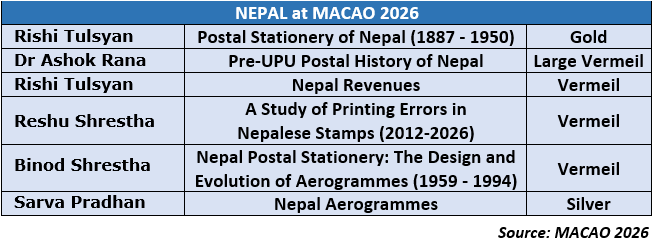 Nepal’s postal stationery from the late 19th and early 20th centuries survives in limited numbers, scattered across private collections and archives. Reconstructing its evolution demands not only collecting rare material but also tracing printing methods, postal regulations, routes and rates—details that judges at world exhibitions scrutinise with forensic precision.
That emphasis on scholarship increasingly defines modern competitive philately. Collections are judged not simply by the rarity of their material but by the originality of their research and the quality of the story they tell.
Nowhere is that more evident than in the work of Dr Ashok Rana, whose exhibit “Pre-UPU Postal History of Nepal” earned a Large Vermeil medal.
Long before Nepal became a member of the Universal Postal Union, its mail travelled through an intricate network shaped by geography, diplomacy and trade. Rana’s research pieces together that overlooked period, revealing how letters navigated political boundaries and mountainous terrain in an era when communication depended almost entirely on human endurance.
Meanwhile, Binod Shrestha was awarded Vermeil for “Nepal Postal Stationery: The Design Evolution of Nepal’s Aerogrammes (1959–1994)”. The exhibit chronicles how the lightweight blue aerogramme—once the cheapest way to send letters overseas—evolved in design and function during three decades of political and social change.
The exhibition also reflected a changing generation of Nepali philatelists.
In the Youth Class, Reshu Shrestha turned her attention to the present rather than focusing solely on 19th-century classics. Her exhibit, “A Study of Printing Errors in Nepalese Stamps (2012–2026)”, received Vermeil. It explores how modern production flaws—misregistrations, colour shifts and other varieties—offer fresh insight into contemporary stamp printing. Sarva Pradhan received a Silver medal for his exhibit “Nepal Aerogrammes”.
Together, the exhibits span almost 140 years of Nepal’s postal history—from the earliest government-issued stationery to modern printing varieties—illustrating how philately has evolved into a discipline that sits at the intersection of history, design, economics and communication.

The organisers said the event was intended to strengthen international philatelic exchanges and encourage collaboration among collectors worldwide. At the same time, it offered visitors a glimpse of Macao’s singular identity—a place where Chinese culture remains central while Portuguese heritage continues to shape its character.