

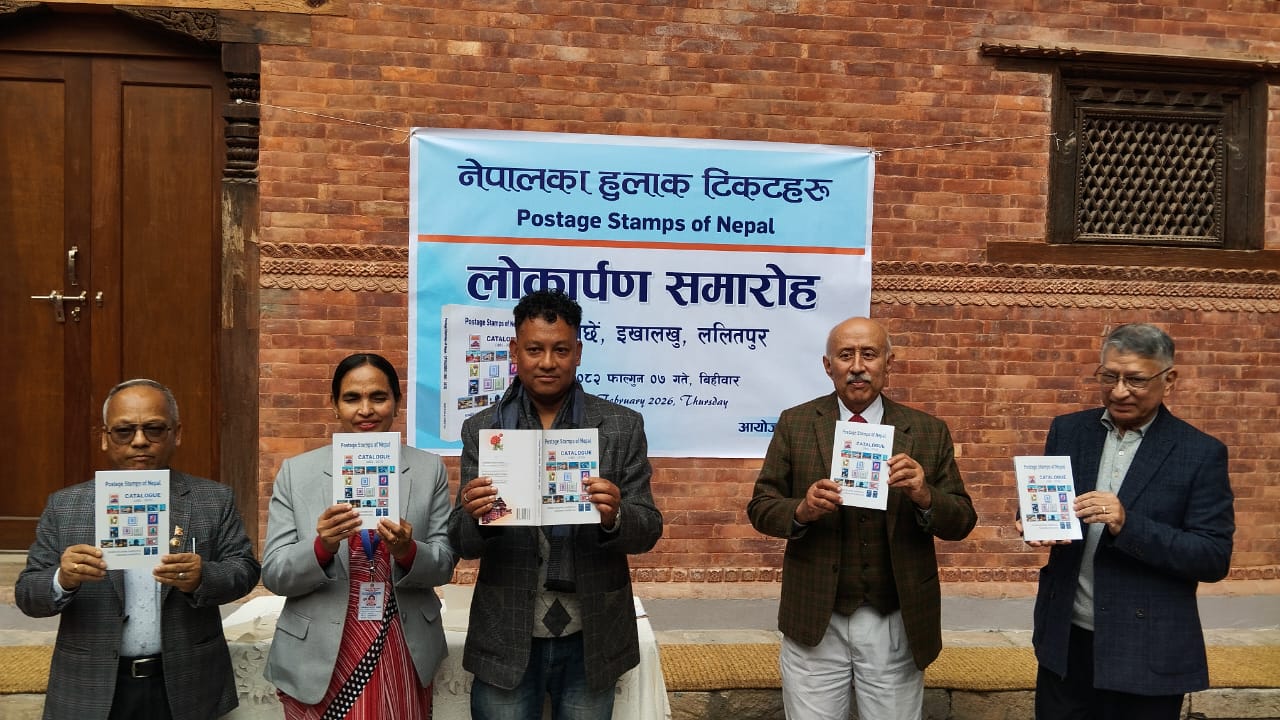
LALITPUR: Collectors and philatelists have a definitive new resource following the unveiling of the Postage Stamps of Nepal Catalogue (1881–2025).
The 200-page volume, co-authored by Binod Krishna Shrestha and Shankar Shrestha, chronicles 144 years of Nepali postal history, listing and valuing 1,489 stamps issued since the country’s first releases in April 1881.
Director General of the Department of Postal Services Manmaya Bhattarai Pangeni, Nepal Philatelic Society President Chandra Rabi Shrestha, Dr. Ashok Rana, and the authors jointly unveiled the catalogue at a function in Lalitpur on Thursday.
Organised chronologically, the catalogue provides suggested market values for mint and used stamps, as well as first-day covers. Each entry is cross-referenced with the Scott and Stanley Gibbons numbering systems for stamps and Dick van der Wateren for postal stationery. Dual dating—Nepali and Gregorian—makes the catalogue clear and accessible for collectors at home and abroad.
The publication builds on earlier work by philatelists Chandra Kumar Sthapit and Deepak Manandhar, first published in 2005 and updated in 2016 and 2022, the authors said. The new edition also incorporates the latest government-issued stamps, reflecting the ongoing evolution of Nepal’s postal record. Valuations are informed by recent auction results and current market trends, according to the authors.
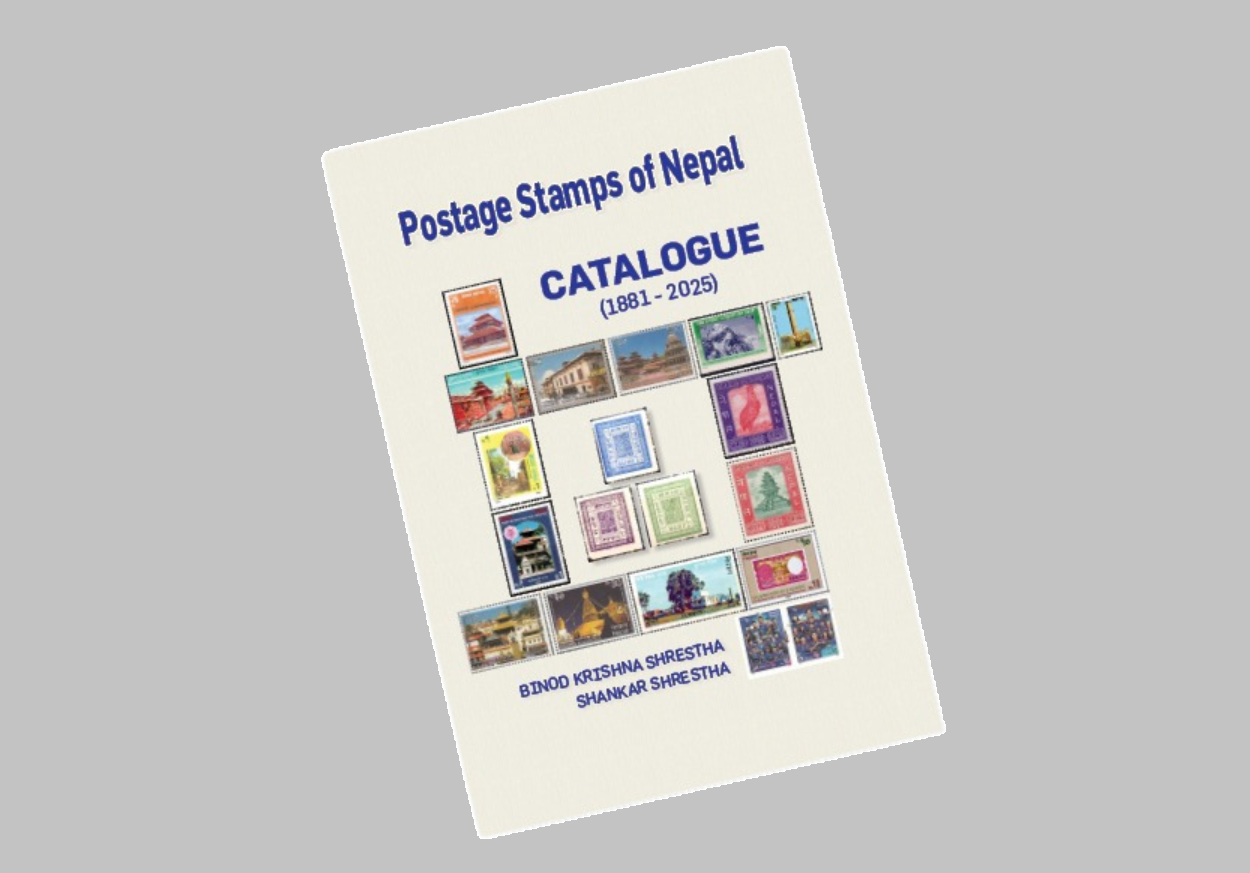 Invariably, Nepal’s iconic 1881 pin-perforated stamps bearing the Sripech and Khukuris (crossed khukuris topped with a crown) are among the standout listings. The ultramarine 1-anna with gum is valued at NRs20,000 (mint) and NRs30,000 (used), the bright purple 2-anna at NRs30,000 (mint) and NRs50,000 (used), and the bright yellow-green 4-anna at NRs30,000 (mint). Only a few of these early stamps circulated through the mail, contributing to their high value.
The catalogue also covers postal stationery, money order stamps, and revenue stamps, expanding its scope beyond standard postage. Its launch comes at a pivotal moment, following the government’s decision to phase out the use of postage stamps on official documents.
Director General of the Department of Postal Services Manmaya Bhattarai Pangeni hailed the catalogue as a landmark contribution that bridges the gap between the public and the postal administration.
“This work is more than a guide. It shines a light on the cultural and historical value of stamps,” she said. “Beyond their postal use, stamps reflect Nepal’s heritage, offering a window into why these tiny pieces of paper matter.”
NPS President Shrestha said the authors might have charted their own course, yet the catalogue remains a treasure for collectors and the wider philatelic community.
Earlier, welcoming philatelic enthusiasts at his newly restored ancestral home in Patan, co-author Binod Krishna Shrestha described the project as a labour of love and archival research. He took them on a journey through Nepal’s stamp history, starting in 1881. With a touch of personal history, he noted that his ancestors had moved into the house just a year after the nation released its first postage stamps.
“This catalogue is the result of countless hours of cross-referencing. We hope it stands as a benchmark for future philatelic work,” he said.
Co-author Shankar Shrestha added, “Each stamp tells a story of the nation’s cultural threads and voice. Historians and collectors should see beyond the perforations to find the soul of Nepal.”
Dr. Rana, fresh from winning a gold medal at the Dubai 2026 World Philatelic Exhibition, delivered a vote of thanks. “The catalogue brings together years of research in a clear, reliable format. It will serve as a valuable reference for collectors and future generations alike.”


